
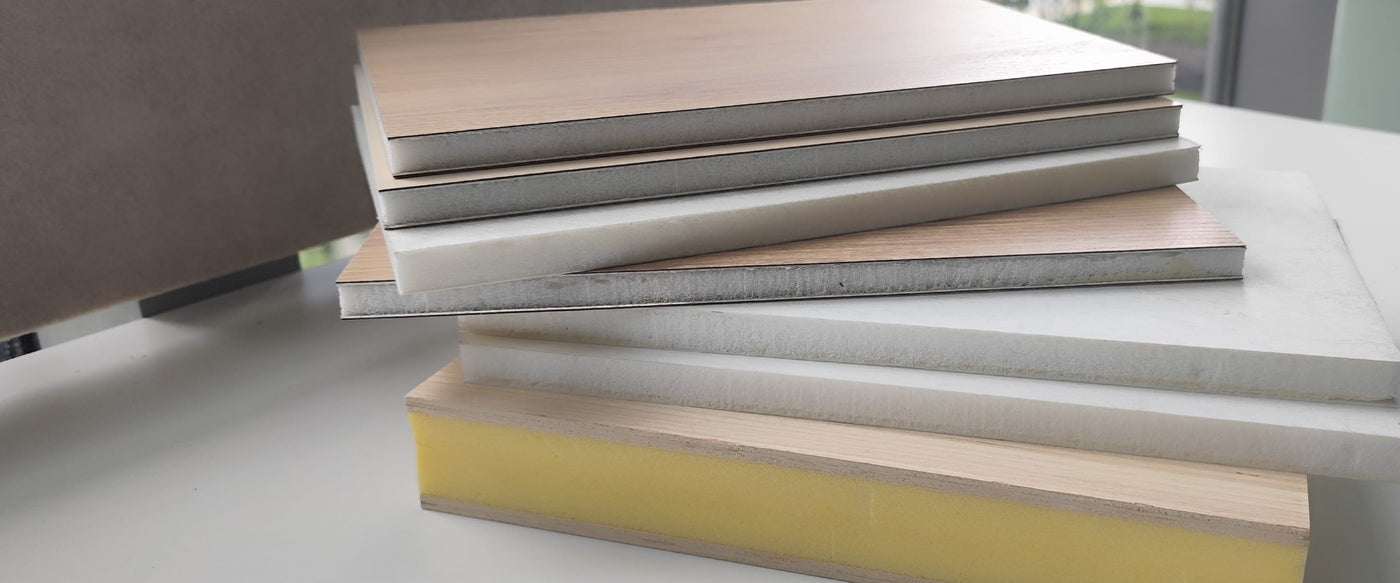


Laminate Options
Compared to standard wood, PET foam board (PET Foam Panel) is regarded as the best lightweighting solution to replace traditional wood in RV furniture manufacturing and body structure construction.
- Aluminum + PP
- Aluminum + PVC
- Aluminum + PET
- Aluminum + Melamine Paper
- HPL
Product Features
- High nail gripping power.
- Easy to cut and process.
- Waterproof.
- Fireproof.
- Resistant to scratches.
- Variety of surface styles.
Application Scenarios
-

RV Structural Exterior Wall Sandwich Panels
25–40 mm, 80–100 kg/m³ density, rigid thermal insulation with superior weather and shear resistance.
-

Motorhome Insulated Roof Panels
30–50 mm, 80 kg/m³ density, lightweight hail protection ensuring high rigidity and thermal barrier integrity.
-

Campervan Heavy-Duty Subflooring
Utilizes 15–20mm thickness, 150–200kg/m³ density, delivering superior compressive strength, zero water absorption, and rot resistance.
-

Travel Trailer Lightweight Furniture
Uses 12–15mm thickness, 100–120kg/m³ density, featuring 600N nail-holding power, E0 zero formaldehyde, and crack resistance.
-

RV Cabin Partition Walls
Applies 9–12mm thickness and 80–100kg/m³ density, providing FST non-toxic safety, lightweight structure, and sound insulation.
-

Caravan Wet Bath Enclosures
Features 12–15mm thickness, 100–120kg/m³ density, offering 100% waterproof protection, mold resistance, and thermal stability.


Surface Treatment
We have HPL panels with diverse surfaces, providing you with more choices for interior decoration.
Related products


Panel Sandwich Manufacturer for OEM & Industrial Supply
Bigbahn supports global buyers with RV Panels and Parts for standard replacement demand, OEM machinery production, and long-term industrial supply programs. From material selection and CNC to grinding, assembly, inspection, and packaging, we focus on stable quality and repeatable supply.
- 80+ Employees
- 3+ Production Lines
- 20+ QC Inspectors
- OEM / ODM Available
- 100% Customization
Specification
| Dimensions | 1220×2440 mm / 1150×2440 mm |
| Core Material | 100kg/m³ PET Foam |
| Thickness | 9, 12, 15, 20, 25, 30 mm |
| Tolerance | Length&Width: +/-1.5mm, Thickness: +/- 0.3mm |
| Minimum Order Quantity (MOQ) | 1x20'GP |
| Density | 100-200kg/m3 (+/-20) / 260-300kg/m3 (+/-20) |
| Surface Treatment | Wood grain, RAL color. |
| Formaldehyde Emission Level | E0 |
| Flexural Strength / Bending Strength | 1.4 MPa - 4.5 MPa |
| Shear Strength | 0.55 MPa - 2.3 MPa |
| Payment Terms | 30% deposit, 70% balance payment against BOL copy |
| Certification | FSC, EUTR, etc. |
Application Fields
-

Standard Yacht Parts
PET foam is used as filler material for ship wall panels and ceilings.
- Reduce resin usage and overall structural weight
- Accelerate time-to-first-part and standardize production
-

Wind Energy
Most wind turbine blades are filled with PET foam.
- Reduce blade weight
- Achieve faster design iterations to shorten development cycles
-

High-Speed Flooring
The floors, siding, and roofs use PET foam as filling material.
- Earthquake-resistant and moisture-proof
- Offers excellent fire resistance, low smoke emission, and is non-toxic


Frequently Asked Questions
What is PET Foam Board?
What is PET Foam Board?
PET Foam Panel is a high-performance, closed-cell thermoplastic structural foam material. It is made from food-grade polyester chips and is a 100% recyclable polymer foam.
What are its Core Characteristics?
What are its Core Characteristics?
The material is characterized by high thermal stability, outstanding mechanical properties, and superior fatigue resistance.
It also features remarkable chemical stability and extremely low water absorption, making it highly moisture-resistant.
Is PET Foam Board safe and environmentally friendly?
Is PET Foam Board safe and environmentally friendly?
Yes, it is completely odorless and has zero formaldehyde emissions.
It is also notable for its FST (Flame retardant, low smoke, non-toxic) properties, typically carrying a B-level fire resistance rating.
What Densities are Available?
What Densities are Available?
BIGBAHN offers several density options to meet different structural needs: 80, 100, 120, 150, 200, and 300 kg/m3.
What are the standard dimensions and thicknesses?
What are the standard dimensions and thicknesses?
- Thickness: Standard options include 9, 12, 15, 20, 25, and 30 mm.
- Size: Standard sheets are either 1220 x 2440 mm or 1150 x 2440 mm.
How strong is the material?
How strong is the material?
Strength varies by density; for instance, the 300 kg/m3 density board has an average compressive strength of 6.8 MPa and a tensile strength of 4.5 MPa.
Its nail-holding power is stable, recorded at approximately 600N.
How does it compare to PVC Foam Board?
How does it compare to PVC Foam Board?
Compared to PVC, PET foam panels are lighter and have a smaller density.
They are also more stable during the nailing process and are significantly less likely to crack than PVC counterparts.
What are the primary applications in the RV industry?
What are the primary applications in the RV industry?
It is considered a perfect substitute for sandwich cores in RV body construction and is an excellent lightweight option for furniture panels, wall panels, and flooring.
What other industries use this material?
What other industries use this material?
Due to its high strength-to-weight ratio, it is used in:
- Wind Power: As a sandwich material for fan blades.
- Automotive: For headliners, boot trim panels, and sun visors.
- Rail Transit: For air ducts, roof door panels, and interiors.
- Building: For insulated wall panels and shaped architectural structures.
Can it be used for decorative purposes?
Can it be used for decorative purposes?
Yes, PET foam is used as the surface slats in BIGBAHN's Grille Panels.
These panels combine a GMT base with PET foam slats to provide an attractive decorative effect along with noise-absorbing and heat-dissipation benefits.


